


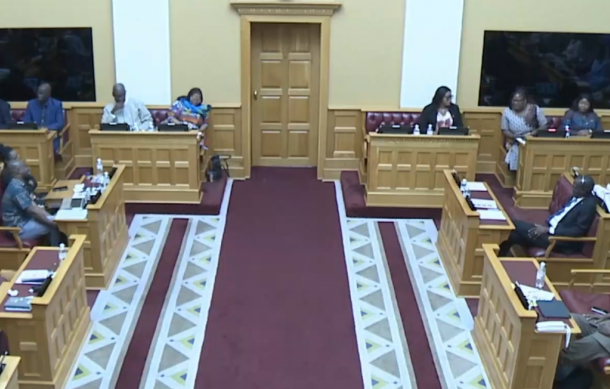
The National Assembly has commenced with the debate on the approval of the Petroleum Amendment Bill.
MPs supporting the Bill stated that Parliament should still maintain oversight in the sector with reports regularly tabled by the line ministry.
“The purpose of this arrangement is not to place the petroleum resource under the personal or unchecked control of the president. Rather, it creates a specialised and coordinated institutional mechanism capable of managing the national interest involved in upstream petroleum development,” said Swapo Party MP Ephraim Nekongo.
“As members of Parliament, our duty is not simply to approve legislation. Our duty is to ensure that legislation creates institutions that will save this country for generations,” noted Swapo Party MP Dr. Tobie Aupindi.
“Let us live a rich legacy, succeeding generations, and that generation will be treasured forever. We owe it to the public out there whose mandate we are saving,” said Deputy Minister of Urban and Rural Development Evelyn !Nawases-Taeyele.
“When it comes to conflict of interest and disclosure, the legislation requires top officials overseeing the sector to formally declare any financial or personal interest in the oil and gas industry,” stated Minister of Information and Communication Technology Emma Theofelus.
“The establishment of the upstream petroleum unity as anticipated in the bill provides an opportunity to strengthen strategic planning, policy coherence, and career separation of power and responsibility, which can improve accountability and accelerate decision-making," explained Swapo Party MP Fenni Nanyeni.
“Strategic oversight remains at the highest level of governance because petroleum resources are of national significance, and operational responsibilities are entrusted to specialists with necessary technical expertise,” added Swapo Party MP Nono Katjingisiua.
Opposition MPs are, however, not in support of the Bill in its current form.
"Like many other bills before it, this proposed legislation fails to clearly outline how communities, particularly those in well-discovered areas, will meaningfully benefit from the exploration activities,” noted LPM MP Aina Kodi.
“A professional, upstream petroleum unit can be useful, but a regulator is not a national petroleum strategy. It cannot decide how much revenue Namibia should retain, how oil wells will be invested for children yet unborn, how local companies will compete, or how an environmental authorisation will become an environmental guarantee,” added PDM MP Inna Hengari.
“Where are the binding requirements for local procurement? What minimum level of participation must Namibian companies achieve? Under what circumstances will joint ventures or partnerships with Namibian companies be required? What enforceable obligations will ensure skills development, technology transfer, and the progressive employment and advancement of Namibians?" questioned PDM MP Winnie Moongo.
“There is a danger that future generations will inherit depleted resources without inheriting sufficient assets, industries, skills, or savings created from those resources," added IPC MP Ottilie Haitota.