


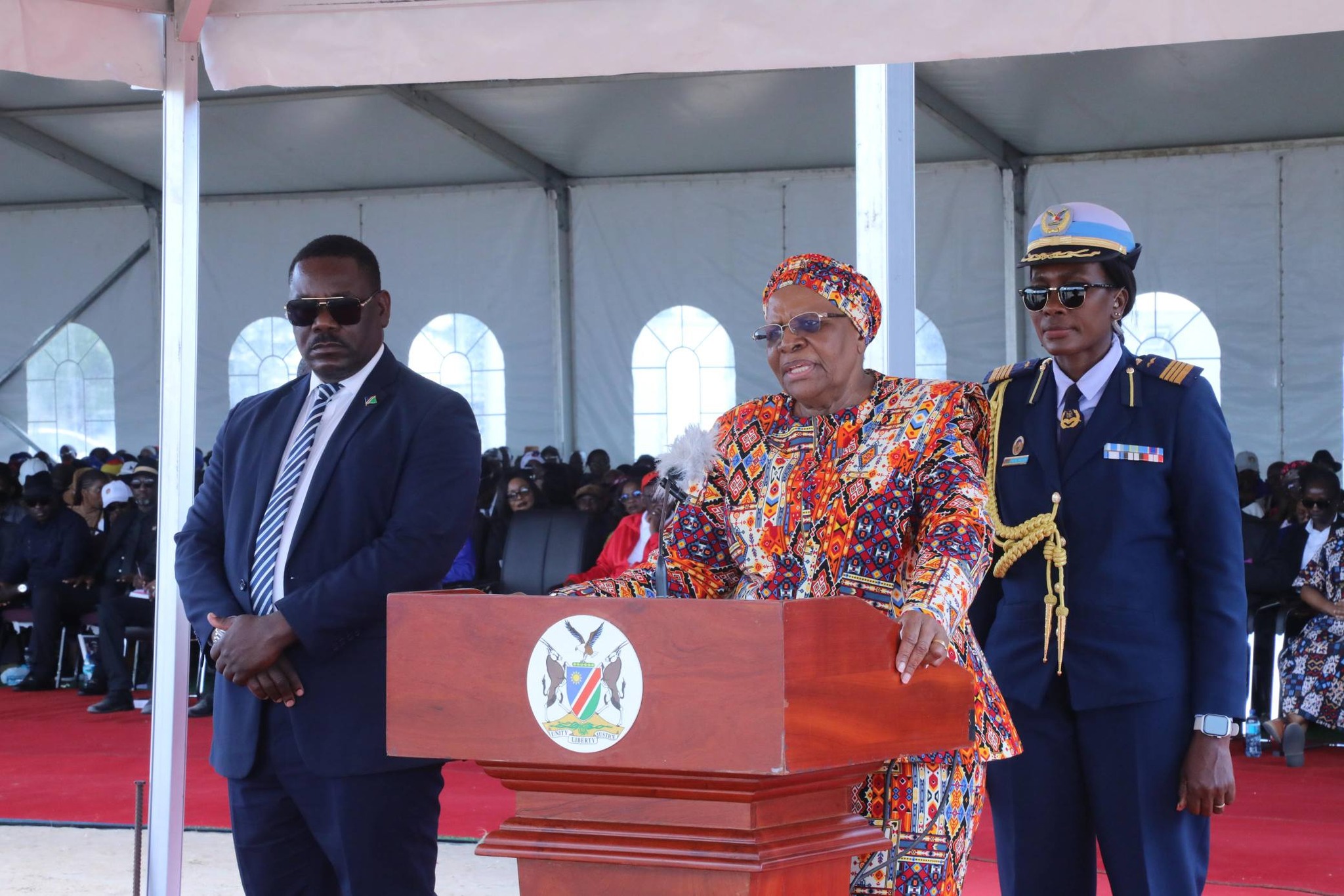
President Netumbo Nandi-Ndaitwah has emphasised the importance of honouring those who died during the Cassinga attack and at other locations.
She urged Namibians to remember the contributions of Cuban nationals who also perished while aiding the survivors.
The President made these remarks at the Cassinga Day commemoration at Olukekete Village in the Omusati Region.
In the same vein, the Head of State stressed that Namibia remains grateful to the government of Angola for its role in Namibia's struggle for independence.
The Cassinga massacre occurred on the 4th of May, 1978, when the South African Defence Force attacked a Namibian refugee camp in southern Angola, killing over 600 people, mostly women, children, and the elderly, and wounding hundreds more.
The President said the cruel and brutal attack on the Cassinga camp was meant to break the spirit of Namibia's liberation struggle, but it instead fuelled Namibians' determination to fight for independence.
Dr. Nandi-Ndaitwah urged Namibians to continue ensuring economic prosperity for all as the country honours its fallen sons and daughters.
She cited that a renewed commitment to unity of purpose should be central and translate into peace and stability for all.
"As we reflect on this painful history and remember the precious blood that continues to water our freedom, we do so mindful that the responsibility to safeguard this peace, stability, and freedom now lies with us and those who will come after us. It is through their blood that waters our freedom that we must remain united to the noble cause for which many Namibians paid the ultimate sacrifice."
Cuba's Ambassador to Namibia, Sergio de la Uz, said Cassinga was not just a massacre but a refusal to give Namibia its freedom.
De la Uz stated that Cuban international troops, who were stationed 15 kilometres away from the Cassinga camp, mobilised to defend the defenceless Namibians and provided medical assistance to those who were injured that day.
On that day, 17 Cubans died and 70 sustained injuries.
"This historic milestone was the first time that Cuban and Namibian blood was shed on the battlefield. This is why Cubans feel pride when we hear the Namibian national anthem affirming 'the blood that watered our freedom', as it acknowledges that Cuban blood also contributed to the freedom of this sister nation."
Omusati Governor Immanuel Shikongo paid tribute to the heroes and heroines of Namibia who sacrificed greatly for their country's independence.
"It serves as a strong reminder of the heavy price paid for Namibia's independence, achieved in 1990, and it calls upon us all to protect that legacy for generations yet to come. We are the custodians of this hard-won freedom, and we must ensure that it flourishes."
Ignatius Mwanyekange, one of the survivors, emphasised the importance of sharing personal accounts to preserve history for future generations.
"I want to say this to my fellow survivors: The responsibility to honour our compatriots falls upon survivors and all Namibians. Let Cassinga Day stand as a promise that our heroes and heroines in Cassinga will never be forgotten. I, therefore, encourage all Cassinga survivors to tell the history of what really happened at Cassinga that fateful day to ensure the true, first-hand narrative of this tragedy is preserved and passed down to the youth and future generations of our country."
Meanwhile, President Nandi-Ndaitwah called upon the youth to learn from history, to embrace the responsibility of nation-building, and to guard against intolerance and injustice in all their forms.
She said the unity and freedom of the nation remain the country's greatest strength, and it is through unity and freedom that it will continue to advance the ideals of the liberation struggle.
The head of state says the nation must also recommit itself to addressing the socio-economic challenges that persist in societies.
She pointed out that true freedom must be accompanied by opportunity, inclusion, and shared prosperity for all Namibians, and that is the responsibility of all citizens to address.
The President and high-ranking government officials laid wreaths at a mass grave of twenty-seven freedom fighters who were killed during an attack at Onhokolo Village on 1st April 1989.
This was the day UN Resolution 435 was supposed to take effect.
This year's commemoration was held under the theme "48 years of honour and sacrifice inspiring the future".